
Insights from Our Vista Curriculum Storyboards Workshop

- 8 mins
Our two-day storyboarding workshop in Vista, Calif., brought the same enthusiasm, generative thinking, and playful attitude of previous workshops.
It’s the same participant experience that never gets old.
There were several participants that continued to work overnight because they were in the groove. Each participant believed that what they were being asked to design was relevant to their students and themselves. In fact, several participants continued to work overnight because they were in the groove.
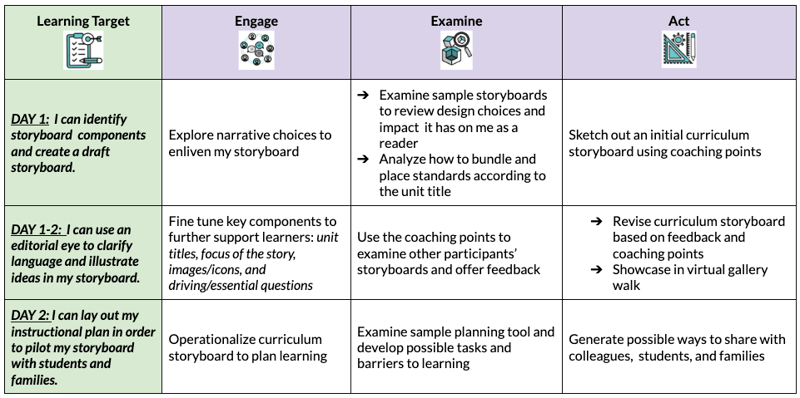
While the enthusiasm was the same as previous workshops, we continue to see the material used in new and innovative ways.
We had the pleasure of coaching a teacher who works as a reading resource specialist.
She was not certain how to lay out a storyboard when she had many different groups of students and her curriculum was all skills based to help students learn to read. We were able to discover a number of ways to help her bring the heavy lift of learning the basics of reading by contextualizing it with sample texts.
She developed a theme in which the students would become detectives of sound and sight as they mastered the phonics and detectives of meaning as they read aloud sample text.
She built in the Habits of Mind, Gathering Data Through All Senses, Listening with Understanding and Empathy, and Questioning and Posing Problems. By the end of the two days, she had laid out the first months of the year in an amazing way of energizing what could be just an experience of diligence to an experience of self-observing confidence.
Such a joy to present together. This was Bena’s first time co-leading a curriculum storyboards workshop and she knocked it out of the park. Her wisdom, connection, and natural storytelling ability brought out the best in our participants.
Allison Zmuda Tweet
The Seemingly Endless Benefits of Curriculum Storyboards
Curriculum Storyboards act as both a deliverable and a process and benefits from leveraging them continue to reveal themselves.
One practical application suggested was using storyboards to show students what would make up an elective course prior to registration.
“They’d be able to see exactly what (the course) is, what’s going to happen, and maybe some of the projects or skills,” explained one participant. “And then maybe we’d have fewer students moving at the beginning of the semester from class to class.”
Another participant echoed that benefit.
“We could pull up the descriptions and they’d say, ‘Oh, that doesn’t make sense,’ and I’m having to summarize it for them, but then I don’t really know exactly what that teacher is going to do exactly.
“So having this as a visual representation (would be helpful) and it would be consistent between parents, other staff members, and students.”
A Storyboard Example
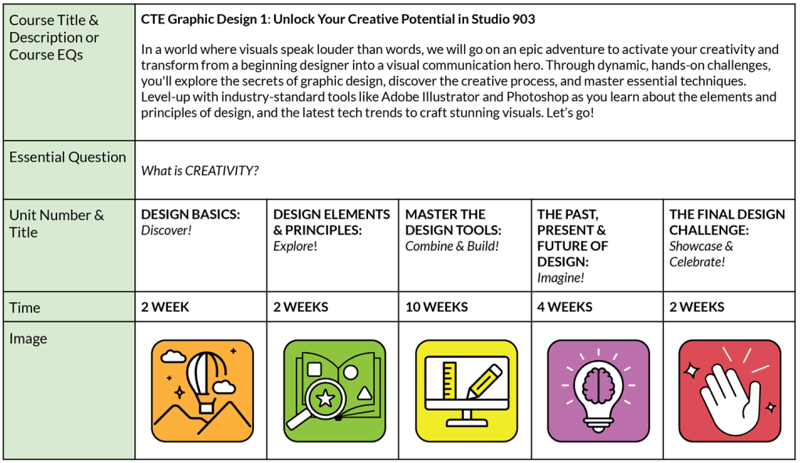
This storyboard was created by Laura Lee Juliano.
She writes, “I want to keep the look of my graphics aligned with branding for Studio 903; it’s an entire experience. I have more work to do on the formatting of the storyboard to get there. I tend to use too many words, so I need some editing. I’m happy with the overall structure and think it’s a pretty epic story to tell.”
Spreading the Joy of Storyboards
Prior to closing our workshop, we asked participants to reflect on how they could share more about their experience without, as Bena stated, “feeling like missionaries going out to conquer the world.”
One individual shared that she had already taken a photo of a seventh grade math storyboard example and sent it to a co-teacher.
“She was super hyped about it,” she said, “she asked, ‘Where’s the material? Is there anything linked there?’ I said, ‘Nope, but we’re going to create it!’ It’s connecting what we already have, just reframing the perspective on each unit or section.”
I loved having the opportunity to work with Allison. She is so masterful at bringing what seems like a lot to happen in two days into a practical plan of action. The energy and enthusiasm was tangible as people became increasingly more playful, creative, and flexible in their thinking.
Bena Kallick Tweet
Looking Ahead to Future Workshops
With another storyboarding workshop in the books, we continue to reflect and improve upon our process.
We find that there is such excitement to want to use the storyboards template right away, so we continue to shorten making the case and examining samples.
So, next time, we will continue to abbreviate the start of the presentation clarifying the problem … especially appropriate for a 1-day immersive experience.
Are You Interested in Bringing A Curriculum Storyboards Workshop to Your School or District?
Reach out to Allison Zmuda for more information!