
From Curriculum Mapping to Curriculum Storyboarding: Our Journey Continues

- 5 mins
Curriculum provides a path to guide us along a learning journey and we have been on that journey for over four decades and we have not yet reached your destination.
Our itinerary has been evolving and changing to accommodate dramatic and rapid world changes. Our purpose and need for education has not changed but new technologies and environmental changes insist that we modify and redirect ourselves.
Heidi and Allison redirected the course of our journey in their book, Streamlining the Curriculum: Using the Storyboard Approach to Frame Compelling Learning Journeys.
For over four decades schools throughout the world educators have been developing curriculum maps to document their learning plans. Software developers met the challenge of developing platforms that enabled teachers to efficiently chart their paths for learning by aligning the content, skills, essential questions, and assessments with state and national standards.
The technology provided a method to show these learning paths across classrooms, grades, and ultimately provide an analysis and framework for the learning journeys of students from K-12. The intention was to foster professional conversations that would thoughtfully create meaningful and important learning for all students.
The good news is that we were able to replace heavy paper notebooks of text with digital records that could be shared and analyzed as a part of our professional development. The bad news is that this created an abundance of information and little time to actually collaborate and make sense of what we were learning.
And then, abruptly in 2020, our journey was redirected from school to home.
This shift accelerated our thinking. Students and parents were unclear about where they were going and the path led to more compliance rather than enjoyment. The language of the curriculum was abstract and didn’t speak directly to the learner. They often saw the work they were doing more as a set of tasks and assignments rather than a connected set of ideas and concepts. There was too much to cover and not enough time to process the learning.
Heidi and Allison addressed the concern of too much to cover by focusing on streamlining the curriculum and using a storyboard to frame the course of study as a connected narrative. And, most importantly, suggested communicating directly to the students and their families in accessible language that sparks curiosity and engagement.
Curriculum storyboarding has breathed new life and a refreshed calibration of the journey so far. In our work sessions with teachers and school leaders, we tap into what every trip requires — a clear understanding of the destination, images that spark our imagining what the trip might entail, and direct storytelling to our students so that the path from one lesson to the next, one unit to the next is narrated to provoke ideas, engage interests, and find connections.
The storyboards tell a story of the learning journey to students. It is an advanced organizer that also invites families and communities to join in the adventure. Parents can anticipate what is coming and plan for activities to support the work in school. Support programs can provide resources and learning opportunities tied to the classroom journeys. And through the transformation of mapping software, the organizer can be the face of the learning journey that links to the components, objectives and resources necessary for quality instruction.
Imagine This: Suppose This Were a Curriculum Storyboard in Your School.
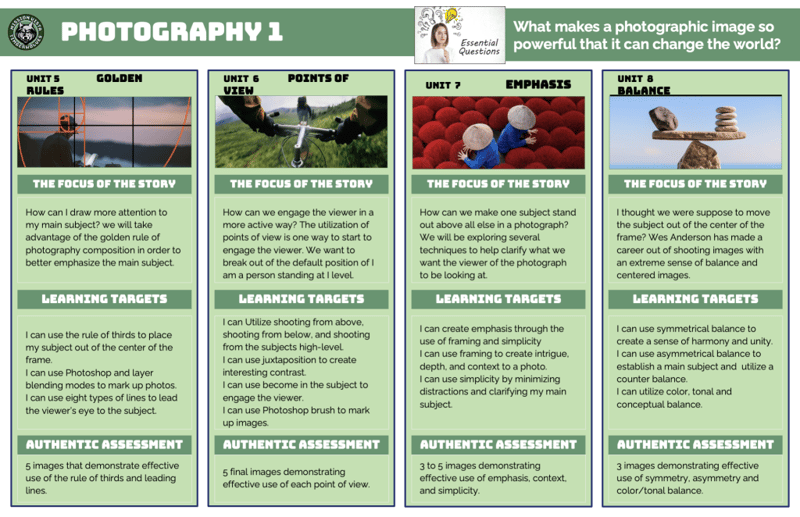
- What jumps out at you when you first look at it?
- Are you drawn first to the image?
- To the question?
- To the focus of the story?
Are You Interested in Working With Storyboards?
Heidi and Allison are offering virtual coaching, in-person workshops, and more. If you are interested in learning more, please reach out!