

- Curriculum Storyboards
- 6 mins
What does a Welsh curriculum storyboard actually look like? How does it transform curriculum communication from dense documents to engaging narratives?
In Part 1, we explored the origins of curriculum storyboarding and why Wales has embraced it as a core strategy in its curriculum transformation. Now let’s move from theory to practice.
What does a Welsh curriculum storyboard actually look like? How does it transform curriculum communication from dense documents to engaging narratives?
Let’s examine two curriculum storyboards from a Year 5 classroom for Summer 2025 from Marc Bowen of Raglan CiW VC Primary School, both built around a powerful unifying theme.
The Unifying Theme: “Undefeated”
Both storyboards are organized around the theme: “Undefeated: A study in a changing planet, changing civilisations, new frontiers and the resilience of the human spirit.”
This isn’t a token connection. The theme provides a meaningful throughline that connects diverse learning experiences—from photography to financial literacy, from geometry to music composition—under a coherent narrative about resilience, identity, and determination.
Storyboard 1: Expressive Arts
The Visual Impact
The first thing that strikes you about this storyboard is its visual appeal. Rather than dense text, it presents four vibrant illustrated panels, each depicting children engaged in creative activities. Before reading a single word, learners and families see active learning, collaboration, and creativity in action.
The visual design isn’t decoration—it’s pedagogy. It communicates expectations and possibilities in ways that text alone cannot.


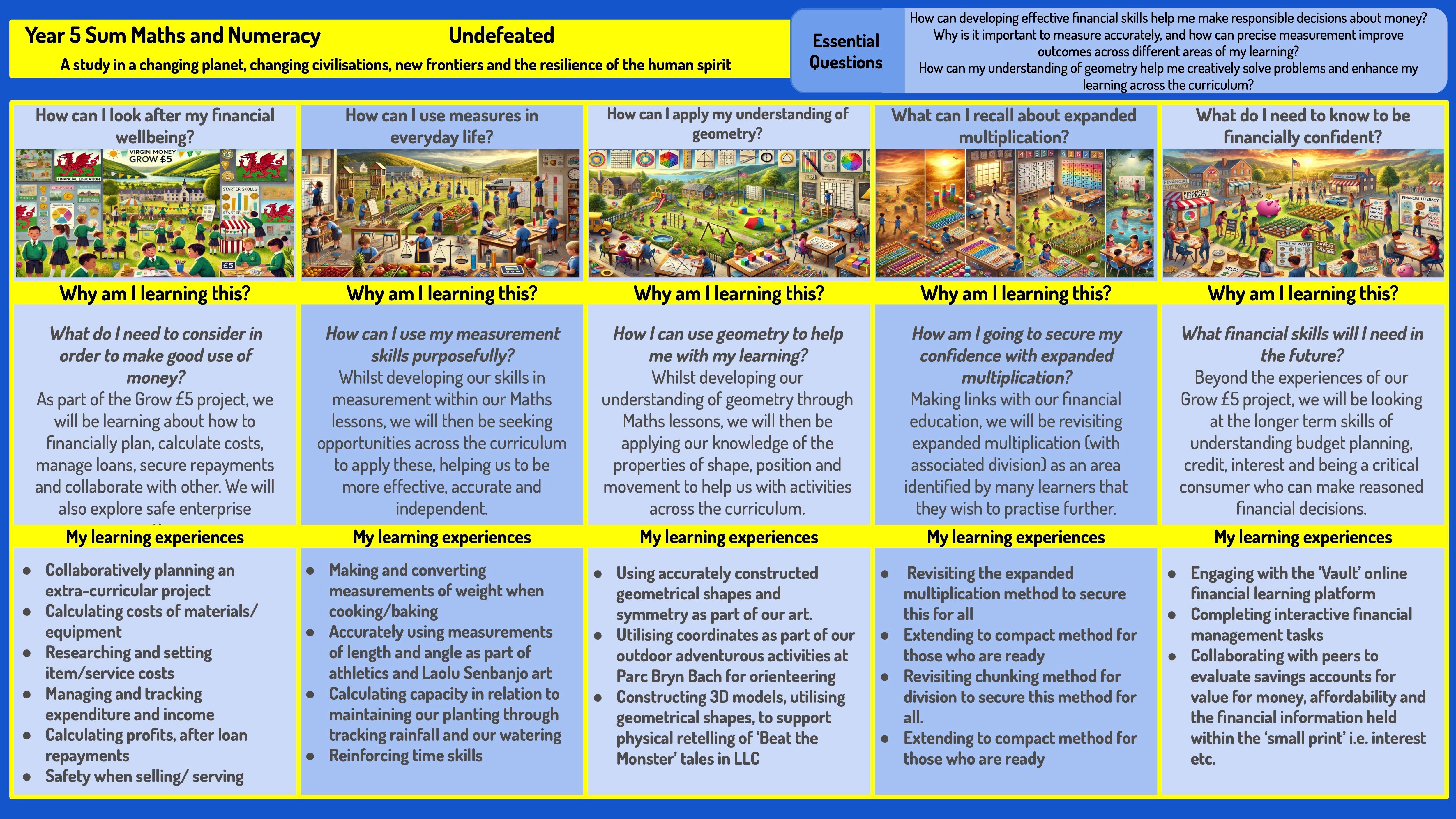
Storyboard 2: Maths and Numeracy
The mathematics storyboard follows the same visual structure but demonstrates how numerical concepts connect to the broader “Undefeated” theme and real-world application.

What Makes These Storyboards Effective?
Several design elements work together to make these storyboards powerful communication tools:
1. Compelling Questions Drive Learning
Compare these approaches:
- Traditional: “Learners will learn photographic composition techniques”
- Storyboard: “How can photography capture character?”
The question format immediately invites curiosity and positions learners as active investigators rather than passive recipients.
2. Student Voice Centers the Learner
The repeated use of “I” and “my” positions learners as active agents. “Why am I learning this?” and “My learning experiences” make clear that this curriculum is designed for learners, not just about them.
3. Purpose is Explicit
Every section includes a “Why am I learning this?” explanation written directly to learners. There’s no mystery about relevance. When learners see they’re learning expanded multiplication to support their real Grow £5 enterprise project, purpose becomes tangible.
4. Connected Learning is Visible
These aren’t isolated topics. The Maths storyboard shows how measurement connects to cooking, athletics, art, gardening, and outdoor adventures. The Expressive Arts storyboard weaves together photography, portrait art, music composition, and coding—all under the unifying “Undefeated” theme.
5. Cross-Curricular Integration is Authentic
Notice the natural connections:
- Humanities research informing art (researching historical figures for silhouette portraits)
- Financial learning connecting to real enterprise skills (Grow £5 project)
- Geometry supporting outdoor activities (orienteering)
- Mathematical measurement applying to art creation (Senbanjo-inspired work)
These aren’t forced connections—they’re authentic applications that make learning feel coherent and purposeful.
6. Language is Accessible
Parents and learners can understand exactly what’s happening and why. There’s no educational jargon obscuring the learning journey. A family looking at the “Grow £5” section immediately grasps that their child will learn real entrepreneurial skills through an authentic project.
7. Visual Design Tells a Story
The illustrations show children collaborating, creating, measuring, problem-solving. The curriculum comes alive visually before learners read a word. This visual storytelling is itself a form of invitation and expectation-setting.
The Contrast with Traditional Curriculum
Consider what a traditional curriculum document might say:
- “Learners will practice expanded multiplication algorithms”
- “Learners will learn photographic composition techniques”
- “Learners will study geometric properties”
The storyboard instead asks:
- “How can photography capture character?”
- “How can I look after my financial wellbeing?”
- “How can I use geometry to help me with my learning?”
The difference isn’t cosmetic. It’s a fundamental shift in how we position learners in relationship to their education—from objects to subjects, from passive to active, from recipients to protagonists.
Looking Ahead
These Year 5 storyboards demonstrate what’s possible when curriculum design prioritizes clarity, purpose, and narrative coherence. But questions remain: Why does this approach align so powerfully with modern curriculum principles? What specific lessons can other education systems learn from Wales?
In Part 3 of this series, we’ll explore why storyboarding works so well for the Curriculum for Wales framework and examine the broader implications for education worldwide.
This is Part 2 of a 3-part series on Wales’ use of curriculum storyboarding. Read Part 1 | Part 3 coming soon
For more information about Wales’ curriculum storyboarding resources, visit the Hwb Tools and Templates page. To see an interview with Marc Bowen(designer extraordinaire) and Yvonne Roberts-Ablett (Head of Curriculum Policy for Welsh Government for more context.